
IPFS & Blockchain — Structural Memo on NFT Permanence
A technical clarification separating decentralized storage from on-chain records.
Architectural Comparison — IPFS vs Blockchain in NFTs
The following table clarifies the structural distinction between decentralized storage and on-chain record systems.
| Layer | IPFS | Blockchain | Impact on Permanence |
|---|---|---|---|
| Primary Function | Stores media files (image, video, metadata JSON) | Stores ownership records and URI references | Complementary roles |
| Data Type | Content-addressed files | Immutable ledger entries | Different persistence logic |
| Guarantee Level | Depends on pinning | Cryptographically secured | Chain permanence ≠ media permanence |
| Failure Scenario | File becomes inaccessible if unpinned | Record remains as long as chain exists | Trace survives even if media disappears |
| Design Responsibility | Creator must ensure distributed pinning | Maintained by network consensus | Storage strategy determines durability |
Visual Architecture Overview
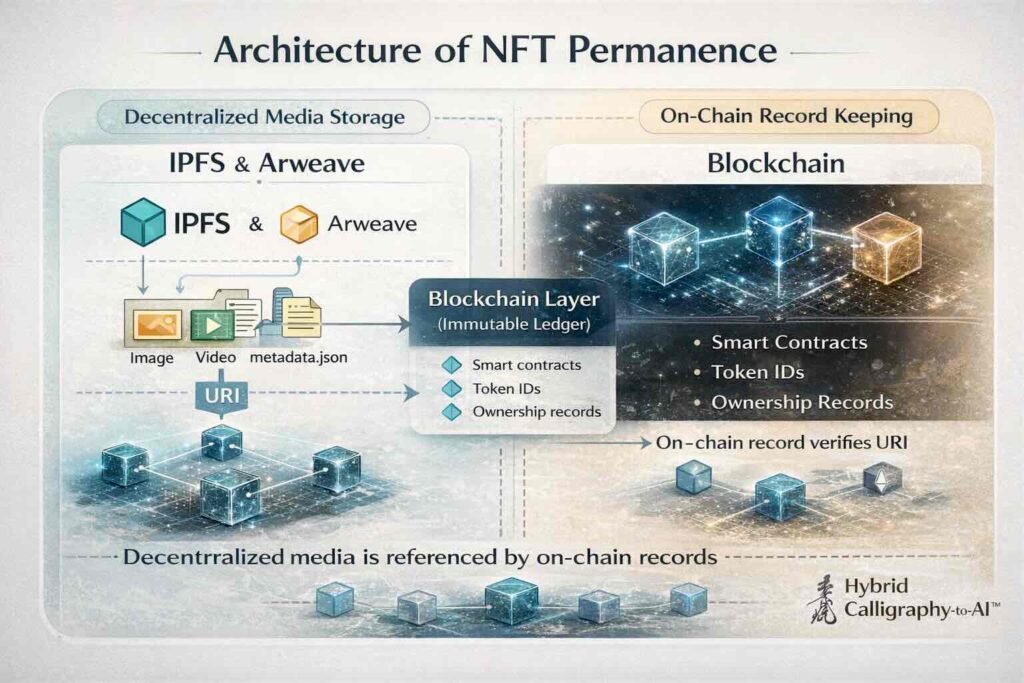
IPFS Is the Media Layer
IPFS primarily stores the visible content of an NFT —
images, video, audio, and metadata files.
It holds what humans actually experience.
IPFS is decentralized,
yet it does not inherently guarantee permanence.
If nodes stop pinning the content,
the file may become inaccessible.
This is not a flaw —
it is the architectural premise.
Blockchain Is the Record Layer
Blockchain does not store the media itself.
It stores structured references:
- Smart contract existence
- Token ID registry
- Ownership and transaction history
- URI pointers to external storage (IPFS / Arweave)
Blockchain preserves verifiable facts —
not files.
The Position of NFT Art
NFT art exists between these two architectural layers.
IPFS makes it perceivable.
Blockchain makes its existence verifiable.
Even if the media disappears,
the on-chain record and historical trace remain.
Impermanence as Design Awareness
NFT art is not inherently eternal.
It is a trace placed
with awareness of technological limits.
IPFS supports perception.
Blockchain supports verifiability.
Permanence ultimately depends on storage design —
and the intention to maintain it.
When NFT Becomes a Record of Intention