
Many creators misunderstand NFT permanence.
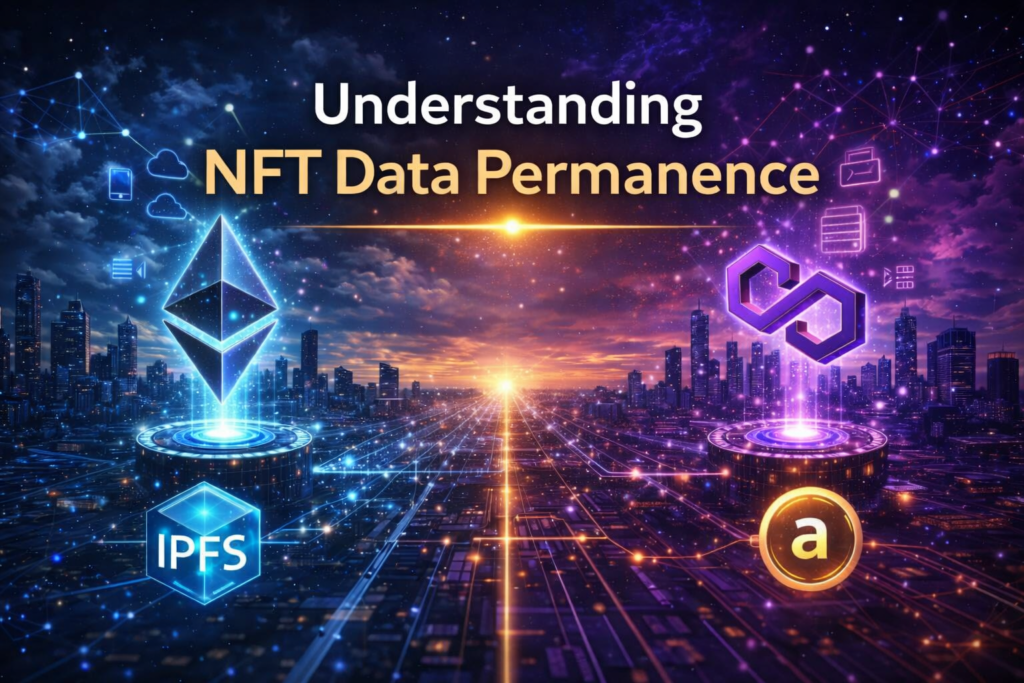
The long-term survival of an NFT does not primarily depend on whether it is minted on Ethereum (ETH) or Polygon (POLYGON).
It depends on where and how the data is stored.
Conclusion First: Permanence Is Determined by Storage, Not the Chain
Whether on Ethereum or Polygon, blockchains typically store only:
- Token ID
- Ownership history
- Metadata URI (a reference link)
The image file and JSON metadata are usually stored off-chain.
Therefore, NFT data permanence is determined by storage architecture.
How NFT Data Is Structured
NFTs generally consist of three layers:
- Smart Contract — stores token ID, ownership, and metadata URI
- Metadata (JSON) — name, description, image URL
- Media File — image, video, or artwork
{
  "name": "My NFT",
  "description": "Example",
  "image": "ipfs://Qm..."
}
Only the reference (URI) is permanently recorded on-chain.
The actual file depends on external storage.
Storage Methods and Their Permanence Levels
1. Centralized Servers (High Risk)
- Server shutdown = NFT disappears
- Domain expiration = broken metadata
- Data can be altered
Permanence: Very Low
2. IPFS (Distributed Storage)
- Content-addressed storage
- Widely used in NFT ecosystems
- Requires active pinning
Permanence: High (if pinned)
3. Arweave (Permanent Storage)
- One-time payment for long-term storage
- Designed for permanent archival
Permanence: Very High
Does Ethereum or Polygon Affect NFT Permanence?
| Factor | Ethereum | Polygon | Impact on Permanence |
|---|---|---|---|
| Smart Contract | Permanent | Permanent | No difference |
| Metadata URI | Permanent reference | Permanent reference | No difference |
| Image Storage | External | External | No difference |
Technically, there is almost no difference in NFT data permanence between ETH and POLYGON.
Why Is Ethereum Often Perceived as More Secure?
The perceived advantage of Ethereum is not technical permanence but social trust:
- Largest node network
- Longest operational history
- Central role in NFT markets
Polygon operates as a Layer 2 ecosystem connected to Ethereum.
In extreme long-term theoretical scenarios, Ethereum may have slightly higher standalone survival probability.
However, this is a decades-long hypothetical consideration.
Best Practices for Maximizing NFT Permanence
- Use IPFS with multiple pinning services (Pinata, NFT.storage, self-hosted node)
- Store critical works on Arweave
- Lock metadata (immutable design)
- Open-source metadata structure when possible
Technical Permanence vs Cultural Permanence
There is a difference between:
- Technical permanence — data does not disappear
- Cultural permanence — someone continues to preserve and value it
Blockchain ensures record persistence.
But meaning ensures survival.
Final Answer
For long-term preservation, Ethereum and Polygon are technically similar in permanence.
The real determinant is storage design.
NFTs do not survive because of the chain alone.
They survive because the data is stored correctly — and because someone chooses to preserve them.
Frequently Asked Questions (FAQ)
Does Ethereum guarantee NFT permanence?
No. Ethereum guarantees the permanence of token ownership and metadata references,
but not the actual image or file storage. NFT media files are usually stored off-chain.
Is Polygon less permanent than Ethereum?
Technically, no. Both Ethereum and Polygon permanently store token data and metadata URIs.
Long-term permanence depends on storage architecture such as IPFS or Arweave.
What happens if NFT metadata is stored on a centralized server?
If the server shuts down or the domain expires, the NFT may lose its image or metadata.
This significantly reduces long-term reliability.
Is IPFS permanent?
IPFS is distributed but requires active pinning.
If no node maintains the data, the file may become unavailable.
Is Arweave truly permanent?
Arweave is designed for long-term archival storage.
A one-time payment funds long-duration preservation, making it more resilient than typical IPFS setups.
What is the safest way to preserve NFT data?
The most secure approach combines IPFS with multiple pinning services,
optional Arweave storage for critical works,
and immutable metadata design.
Does blockchain choice affect NFT cultural permanence?
Technical permanence and cultural permanence differ.
Blockchain preserves records, but community engagement preserves meaning.
Written by Benny-K
NFT infrastructure researcher and creator of Hybrid Calligraphy-to-AI™ Method.