How to Use This Guide
This is a comprehensive master-level NFT guide.
If you prefer to navigate strategically, use the sections below:
- New to NFTs? → Start with Sections 1–6
- Interested in Market Analysis? → Go to Sections 7–11
- Planning to Create or Sell NFTs? → Read Sections 12–16
- Researching NFT Economics? → Focus on Sections 7–11
You may also read sequentially for a complete structural understanding.
Toward a Complete NFT Encyclopedia – A Globally Comprehensive Master Guide
This document is designed as a structural reference work on NFTs (Non-Fungible Tokens).
It integrates foundational definitions, blockchain architecture, economic theory,
market data, strategic execution, and long-term implications.
Rather than functioning as a short beginner article,
this guide aims to serve as a durable encyclopedic resource
for creators, collectors, developers, and researchers.
1. Executive Overview: What Is an NFT in One Paragraph?
An NFT (Non-Fungible Token) is a cryptographically verifiable digital ownership record stored on a blockchain.
If you are searching “What is an NFT?” this guide provides the most complete structural explanation available.
Unlike cryptocurrencies such as Bitcoin or Ether, each NFT is unique and cannot be replaced by another identical unit.
NFTs enable digital files—such as images, music, videos, memberships, or in-game assets—to carry provable ownership,
transfer history, and programmable conditions within decentralized infrastructure.
In simple terms:
NFTs transform digital data into verifiable digital property.
For a conceptual perspective beyond market mechanics, see our
digital talisman and traditional amulet comparison, which explains how symbolic intention differs from traditional ritual objects.
2. Foundational Definition of NFTs
2.1 What Does “Non-Fungible” Mean?
Fungible assets are interchangeable.
One dollar equals another dollar.
One Bitcoin equals another Bitcoin.
Non-fungible assets are unique.
A specific painting, a signed manuscript, or a parcel of land
cannot be replaced by another identical unit.
NFTs encode non-fungibility into blockchain-based systems.
Each token contains a unique identifier,
ensuring that no two NFTs are identical.
2.2 NFTs Are Not the Image Itself
A common misunderstanding is that NFTs are digital images.
In reality, an NFT is a token that references metadata.
The blockchain records:
- The creator’s wallet address
- The current owner’s wallet address
- The transaction history
- The token ID
The digital file itself is usually stored externally
(on IPFS, Arweave, or similar systems).
The NFT contains the verifiable ownership pointer.
2.3 Ownership vs Possession
Anyone can copy a JPEG.
However, ownership in the blockchain sense
refers to the wallet address that controls the NFT token.
NFT ownership is cryptographic possession of the token’s private key authority.
This distinction is fundamental.
3. Blockchain Infrastructure
3.1 What Is a Blockchain?
A blockchain is a distributed ledger system
that records transactions in cryptographically linked blocks.
Key properties:
- Decentralization
- Immutability
- Transparency
- Cryptographic verification
These characteristics allow NFTs to function
without centralized ownership registries.
3.2 Major NFT-Supported Blockchains
- Ethereum
- Polygon
- Solana
- BNB Chain
- Avalanche
- Arbitrum
- Base
Ethereum remains the central infrastructure of the NFT market,
and its native cryptocurrency is ETH (Ether).
It has the largest developer ecosystem,
the highest liquidity concentration,
and the strongest institutional adoption among NFT blockchains.
Polygon and Solana are characterized by lower transaction costs
and faster confirmation speeds.
These properties make them suitable for beginners,
high-frequency minting projects,
and smaller-scale creators.
BNB Chain and Avalanche provide scalable alternatives,
while Arbitrum and Base operate as Ethereum Layer-2 networks,
reducing gas fees while maintaining compatibility with Ethereum smart contracts.
3.3 Layer 1 vs Layer 2
Layer 1 blockchains (e.g., Ethereum) operate as base settlement layers.
Layer 2 networks (e.g., Arbitrum, Base) execute transactions off the main chain
and periodically settle results back to Layer 1.
This reduces transaction costs and increases throughput.
4. Gas Fees and Transaction Mechanics
4.1 What Is a Gas Fee?
Gas fees are transaction processing fees required to execute operations on a blockchain.
They compensate network validators for computational work.
On Ethereum:
Gas Fee = Gas Limit × Gas Price
Gas fees fluctuate depending on network congestion.
Layer-2 solutions significantly reduce gas costs.
4.2 Why Gas Matters in NFT Strategy
High gas fees impact:
- Mint pricing strategy
- Collector accessibility
- Marketplace liquidity
- Entry-level adoption
Therefore, blockchain selection is not only technical,
but economic and strategic.
5. NFT Technical Architecture
5.1 ERC-721 Standard
ERC-721 defines a standard for unique tokens.
Each token has a distinct ID and ownership mapping.
5.2 ERC-1155 Standard
ERC-1155 allows multiple token types within one contract.
It enables batch minting and efficient transfers.
Learn more about ERC-1155 structural logic here →
https://powerfulnft.com/erc1155-metadata-name-discrepancy/
5.3 Smart Contracts
NFT logic is governed by smart contracts.
These contracts define:
- Minting rules
- Transfer permissions
- Royalty mechanisms
- Metadata structure
Once deployed, smart contracts are generally immutable.
5.4 Metadata and Storage
Technical architecture overview →
https://powerfulnft.com/hybrid-structural-flow/
NFT metadata typically includes:
- Name
- Description
- Image URL
- Attributes
Storage options:
- IPFS (decentralized file storage)
- Arweave (permanent storage)
- Centralized cloud servers
Decentralized storage improves resilience.
6. NFT vs Cryptocurrency
Cryptocurrencies are fungible units of exchange.
NFTs are unique digital property identifiers.
- 1 ETH = another 1 ETH
- 1 NFT ≠ another NFT
Cryptocurrency provides liquidity.
NFT provides uniqueness.
For symbolic distinctions beyond asset mechanics, see
talisman vs amulet explained
.
7. Global NFT Market Data and Structural Trends (2021–2025)
7.1 Historical Market Expansion and Contraction
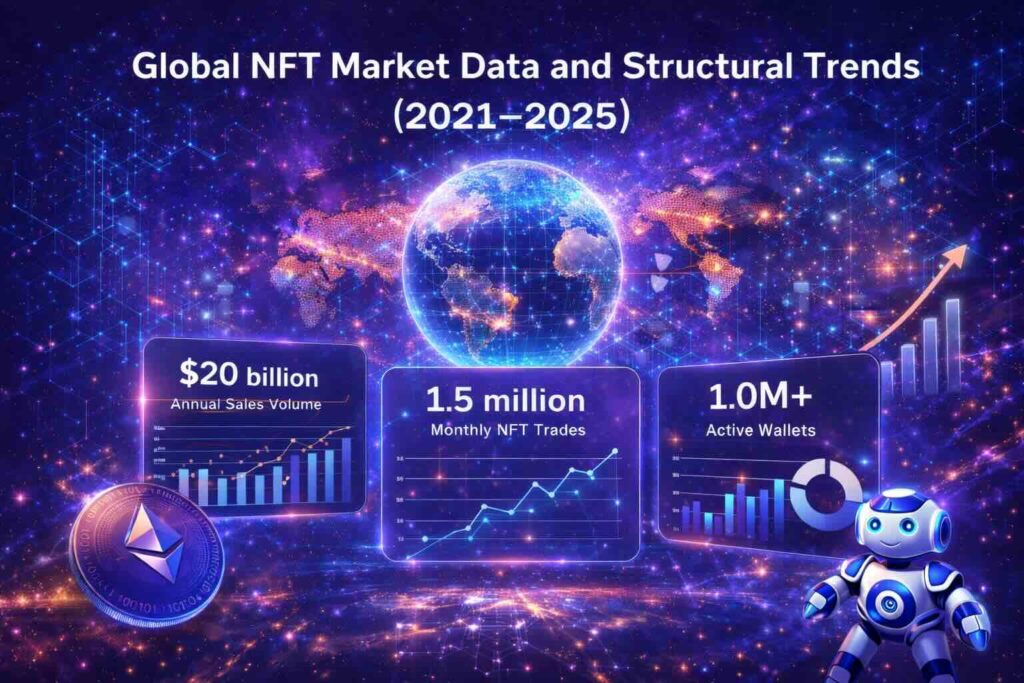
The NFT market entered mainstream awareness in 2021.
Annual transaction volume exceeded an estimated $20 billion USD,
driven largely by speculative activity, PFP collections,
and high-profile digital art sales.
In 2022, overall transaction volume declined significantly,
with estimates ranging between $8–12 billion depending on methodology.
However, infrastructure metrics such as:
- Total active wallets
- Smart contract deployments
- Developer commits to Web3 repositories
- Layer-2 scaling adoption
continued to grow, indicating structural maturation beyond speculative cycles.
7.2 Active Wallet Growth
Despite price volatility, the number of unique wallet addresses interacting with NFT contracts
has demonstrated long-term growth.
| Year | Estimated Unique NFT Wallets | Trend |
|---|---|---|
| 2020 | ~500,000 | Emerging |
| 2021 | ~3 million | Explosive growth |
| 2022 | ~5 million | Expansion with volatility |
| 2023–2024 | ~7–10 million | Infrastructure consolidation |
The growth of wallets suggests that NFTs have moved from novelty
to embedded digital infrastructure.
8. Blockchain-Level Statistical Comparison
8.1 NFT Activity by Chain (Relative Trends)
| Blockchain | Typical NFT Segment | Gas Cost Range | Market Perception | Strategic Strength |
|---|---|---|---|---|
| Ethereum | High-value 1/1 Art | High (variable) | Premium / Institutional | Liquidity depth |
| Polygon | Mass mint / Brand NFTs | Low | Accessible | Cost efficiency |
| Solana | PFP / Gaming | Very Low | Speed-focused | High throughput |
| BNB Chain | Utility NFTs | Low | Alternative ecosystem | Exchange integration |
| Arbitrum | Layer-2 scaling | Low | Ethereum-aligned | Reduced gas |
| Base | Emerging L2 | Low | Institutionally backed | Regulatory alignment |
Chain selection influences not only cost,
but collector demographics, perceived prestige, and liquidity.
9. Category-Based NFT Economic Analysis
9.1 Primary Mint Price Distribution (USD Equivalent)
| Category | Mint Price Range | Supply Model | Revenue Logic |
|---|---|---|---|
| 1/1 Digital Art | $500 – $10,000+ | Single unique | Collector value |
| PFP Collections | $50 – $300 | 5,000–10,000 supply | Community scale |
| Gaming NFTs | $10 – $200 | Variable | Utility-driven |
| Music NFTs | $5 – $100 | Limited editions | Fan monetization |
| Membership NFTs | $20 – $500 | Access-based | Subscription model |
9.2 Secondary Market ROI Patterns
Secondary price performance depends primarily on:
- Community cohesion
- Creator reputation
- Narrative strength
- Liquidity availability
| Category | Typical ROI Multiplier (Cycle Peak) | Volatility Level |
|---|---|---|
| PFP | 2.0x – 5.0x | High |
| 1/1 Art | 1.2x – 2.0x | Moderate |
| Gaming | 1.0x – 1.5x | Medium |
| Utility | 1.1x – 1.8x | Medium |
Speculative intensity is highest in large-scale PFP ecosystems.
Art-based NFTs exhibit slower but more stable price movement.
10. Marketplace Structural Liquidity Analysis
| Marketplace | Liquidity Depth | Fee Structure | Collector Type | Strategic Role |
|---|---|---|---|---|
| OpenSea | Very High | ~2.5% | General market | Global baseline |
| Blur | High | Low | Professional traders | High-frequency trading |
| Magic Eden | High (Solana) | ~2% | Gaming / PFP | Speed market |
| Foundation | Curated | Higher | Art collectors | Premium positioning |
| Rarible | Moderate | Variable | DAO-oriented | Custom deployment |
Liquidity concentration heavily impacts resale probability.
Market depth correlates directly with price stability.
11. Academic Economic Framework
11.1 Scarcity Economics
Scarcity is foundational to NFT value.
Unlike infinite digital copies, NFT supply can be mathematically limited.
Scarcity alone, however, does not generate value.
Perceived desirability must accompany scarcity.
11.2 Network Effects
NFT ecosystems demonstrate network effects:
The value of a collection increases as community participation expands.
This creates positive feedback loops,
but also vulnerability to sentiment shifts.
11.3 Information Asymmetry
NFT markets exhibit high information asymmetry.
Buyers rely on:
- Reputation signals
- Social proof
- Brand authority
- On-chain transparency
Price formation often follows:
Price = Utility × Narrative × Social Capital
11.4 Cultural Capital Theory
Ownership of certain NFTs functions as symbolic capital.
It signals status, alignment, or cultural belonging.
This sociological dimension plays a significant role in high-value NFT markets.
12. How to Buy NFTs – A Complete Operational Framework
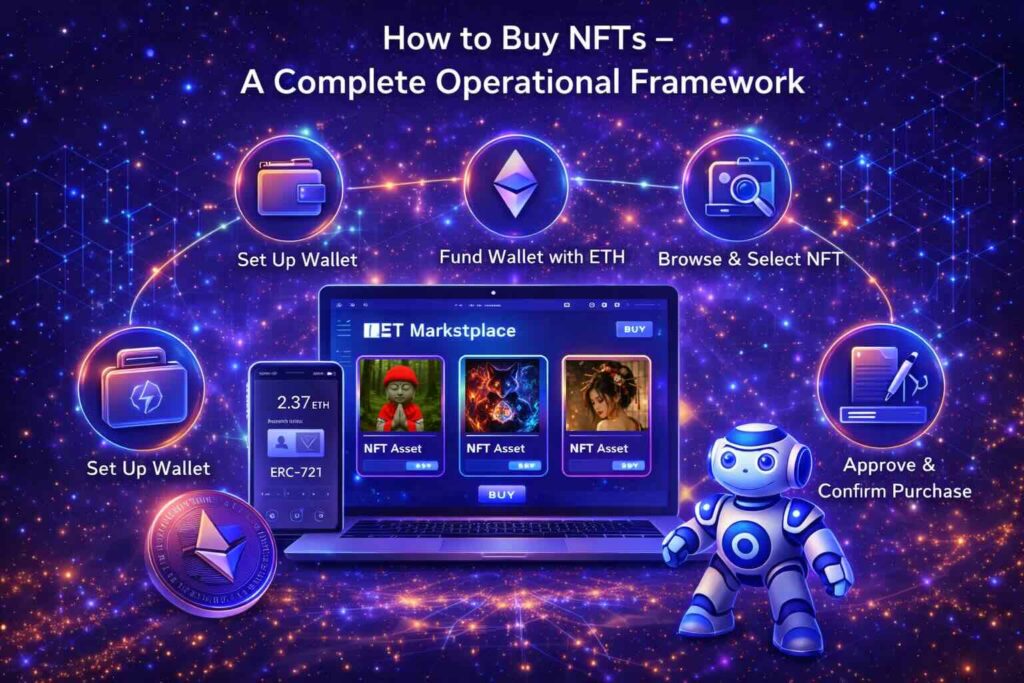
12.1 Step 1: Create a Secure Web3 Wallet
To interact with NFTs, you must first create a non-custodial Web3 wallet.
This wallet stores your private keys and allows you to sign blockchain transactions.
Common Wallets:
- MetaMask
- Phantom
- Trust Wallet
- Coinbase Wallet
- OKX Wallet
- Rainbow Wallet
When creating a wallet, you will receive a seed phrase (typically 12–24 words).
This phrase grants full access to your assets.
If lost, your assets cannot be recovered.
If shared, your assets can be stolen.
12.2 Step 2: Acquire Cryptocurrency
NFTs are purchased using cryptocurrency.
You must obtain the native token of the blockchain on which the NFT exists.
Major Global Exchanges:
- Binance
- Coinbase
- Kraken
- OKX
- Bybit
- KuCoin
Standard Flow:
- Create exchange account
- Complete KYC verification
- Deposit fiat currency
- Purchase ETH, SOL, or other required token
- Transfer funds to your Web3 wallet
12.3 Step 3: Connect to an NFT Marketplace
Major NFT Marketplaces:
- OpenSea
- Blur
- Magic Eden
- Foundation
- Rarible
- SuperRare
- LooksRare
After connecting your wallet,
you may purchase NFTs via:
- Fixed price
- Timed auction
- Offer submission
All transactions require blockchain confirmation.
Once confirmed, the NFT appears in your wallet address.
13. How to Sell NFTs – Complete Strategic Framework
13.1 Conceptual Foundation
Before minting, define:
- Artistic or utility concept
- Supply structure (1/1 or multiple)
- Blockchain selection
- Royalty percentage
- Target collector demographic
13.2 Minting Process
- Create collection on marketplace
- Upload artwork or metadata
- Select blockchain
- Set supply and royalty
- Deploy contract / Mint token
Minting permanently records the NFT on-chain.
Detailed minting case record →
https://powerfulnft.com/digital-talisman-ecosystem/
13.3 Pricing Strategy
Pricing models include:
- Low-entry mass mint
- Premium 1/1 positioning
- Dutch auction
- Tiered release model
Price positioning affects brand perception.
Undervaluation may damage long-term positioning.
14. Security and Risk Modeling
14.1 Wallet Security
- Never share private keys
- Store seed phrases offline
- Use hardware wallets for high-value assets
- Avoid signing unknown transactions
14.2 Phishing and Smart Contract Risk
Common attack vectors include:
- Fake mint websites
- Malicious contract approvals
- Social engineering
Always verify:
- Official project URLs
- Verified contract addresses
- Marketplace authenticity
14.3 Market Volatility Risk
NFT pricing is highly volatile.
Liquidity can disappear rapidly during market downturns.
Risk mitigation includes:
- Diversification
- Long-term holding strategy
- Fundamental analysis over hype
15. Legal and Tax Considerations
15.1 Taxation
In many jurisdictions:
- Crypto-to-crypto trades are taxable events
- NFT sales generate capital gains
- Royalties may be considered income
Regulations vary globally and continue to evolve.
Consult local tax professionals.
15.2 Regulatory Landscape
Regulatory frameworks differ across countries.
Some classify NFTs as digital goods,
others may evaluate them under securities frameworks depending on structure.
Compliance considerations include:
- KYC requirements
- Consumer protection law
- Intellectual property law
16. NFT Strategic Launch Modeling
16.1 Pre-Launch Architecture
- Community building
- Whitelist strategy
- Supply limitation
- Transparent roadmap
16.2 Liquidity Strategy
Liquidity concentration on major marketplaces increases price stability.
16.3 Long-Term Ecosystem Building
- DAO integration
- Token-gated access
- Secondary utility expansion
17. NFT and DAO Integration
NFTs can function as governance tokens within DAOs.
They may grant:
- Voting rights
- Membership privileges
- Revenue participation
This transforms NFTs from static art objects into programmable governance assets.
Explore the PowerfulJIZO Ecosystem →
https://powerfulnft.com/powerfuljizo-ecosystem/
18. The Future of NFTs
- Digital identity verification
- On-chain academic certification
- Real-world asset tokenization (RWA)
- Metaverse property systems
- Decentralized brand ecosystems
NFTs represent a structural evolution of ownership in the digital era.
They formalize trust, scarcity, and transferability within decentralized networks.
19. Frequently Asked Questions (Comprehensive FAQ)
1. What is an NFT in simple terms?
An NFT is a unique digital ownership certificate recorded on a blockchain.
2. Is an NFT the same as cryptocurrency?
No. Cryptocurrency is fungible. NFTs are unique and non-interchangeable.
3. Can NFTs be copied?
The digital file can be copied, but ownership of the NFT cannot be duplicated.
4. Why do NFTs have value?
Value derives from scarcity, ownership history, cultural capital, and market demand.
Why NFT Art Started at 30,000 ETH
5. Are NFTs only for digital art?
No. NFTs represent art, music, gaming assets, memberships, tickets, and digital identity.
6. What blockchain is best for NFTs?
Ethereum dominates high-value art; Polygon and Solana offer lower fees and scalability.
7. What is gas?
Gas is the transaction fee required to execute operations on a blockchain.
8. Are NFTs environmentally harmful?
Modern proof-of-stake blockchains significantly reduce energy consumption compared to early systems.
9. What is minting?
Minting is the process of recording a new NFT onto a blockchain.
10. Can NFTs be deleted?
Blockchain records are immutable. NFTs cannot be deleted once minted.
11. What is ERC-721?
A token standard for unique NFTs on Ethereum.
12. What is ERC-1155?
A multi-token standard allowing batch minting within a single contract.
13. What is IPFS?
A decentralized file storage protocol often used to host NFT metadata and media.
14. What is a DAO?
A decentralized autonomous organization governed by token holders.
15. Can NFTs generate royalties?
Yes. Smart contracts can program royalty payments on secondary sales.
16. Are NFTs regulated?
Regulation varies globally and continues to evolve.
17. Do I need technical skills to buy NFTs?
No, but understanding wallets and security practices is essential.
18. What happens if I lose my seed phrase?
You permanently lose access to your assets.
19. Can NFTs represent real-world assets?
Yes. Real estate, intellectual property, and physical goods can be tokenized.
20. Are NFTs a bubble?
Speculative bubbles have occurred, but underlying blockchain infrastructure continues to develop.
21. What is secondary market trading?
Buying and selling NFTs after the initial mint.
22. How do I evaluate an NFT project?
Assess community, transparency, utility, roadmap, and on-chain data.
23. What is floor price?
The lowest listed price for an NFT within a collection.
24. What is liquidity in NFTs?
The ease with which an NFT can be resold.
25. Are NFTs anonymous?
Wallets are pseudonymous, but blockchain transactions are publicly visible.
26. What is cultural capital in NFTs?
The symbolic status and identity associated with owning specific NFTs.
27. Can institutions use NFTs?
Yes. Brands and enterprises use NFTs for loyalty systems and digital engagement.
28. What is token gating?
Restricting access to content or services based on NFT ownership.
29. What risks exist in NFT investing?
Volatility, fraud, liquidity collapse, and regulatory changes.
30. What is a hardware wallet?
A physical device used to securely store private keys offline.
31. Can NFTs appreciate long term?
High-quality projects with strong communities and narratives may retain value.
32. What is market depth?
The volume of buy and sell orders available in a marketplace.
33. Are NFTs taxable?
Often yes. Tax treatment varies by jurisdiction.
34. What is wash trading?
Artificial trading activity to inflate volume metrics.
35. What is metadata immutability?
The degree to which NFT metadata can be altered after minting.
36. What is real-world asset tokenization (RWA)?
Converting physical assets into blockchain-based tokens.
37. How do NFTs relate to Web3?
NFTs enable ownership and identity within decentralized internet systems.
38. Can NFTs expire?
Standard NFTs do not expire, but smart contracts can include time-based logic.
39. What determines NFT prestige?
Network effects, brand strength, and collector perception.
40. What is long-term NFT sustainability?
Sustainable NFTs rely on utility, governance, community, and real adoption rather than speculation.
41. Can NFTs function as digital identity?
Yes. NFTs can encode credentials and verification data.
42. Are NFTs permanent?
Blockchain records are permanent, but off-chain media storage may vary.
20. Final Integrated Conclusion
NFTs are not merely digital collectibles.
They represent a structural shift in how ownership,
scarcity, and trust are formalized within digital systems.
From foundational blockchain architecture,
to market data analysis,
to economic theory,
to operational execution,
NFTs integrate cryptography, economics, sociology, and network design.
The speculative cycles of early adoption do not define the long-term trajectory.
The enduring transformation lies in programmable ownership,
transparent history,
and decentralized governance.
NFTs redefine what it means to own something in the digital age.
As infrastructure matures,
the intersection of NFTs with digital identity,
real-world asset tokenization,
DAO governance,
and global cultural systems
will continue to expand.
Understanding NFTs requires technical literacy,
economic reasoning,
strategic discipline,
and security awareness.
When viewed holistically,
NFTs are not hype artifacts —
they are components of a broader reconfiguration
of digital property rights.
Master Guide Completion Notice
This document now integrates:
- Foundational definitions
- Blockchain architecture
- Gas and technical standards
- Market data analysis
- Statistical comparison tables
- Economic and academic theory
- Operational buying and selling guides
- Security modeling
- Legal considerations
- Strategic launch frameworks
- 40+ SEO-optimized FAQ entries
This completes the fully integrated master version.
Disclaimer
This guide reflects independent research and structured analysis as of February 25, 2026.
Every effort has been made to ensure accuracy; however, blockchain technologies,
market dynamics, and regulatory frameworks evolve rapidly.
This material is provided strictly for educational and informational purposes.
It does not constitute financial, legal, tax, or investment advice.
Readers should conduct independent due diligence and consult qualified professionals before making financial decisions.
Last Updated: February 25, 2026