When creating or buying NFTs, one of the first decisions is choosing the blockchain.
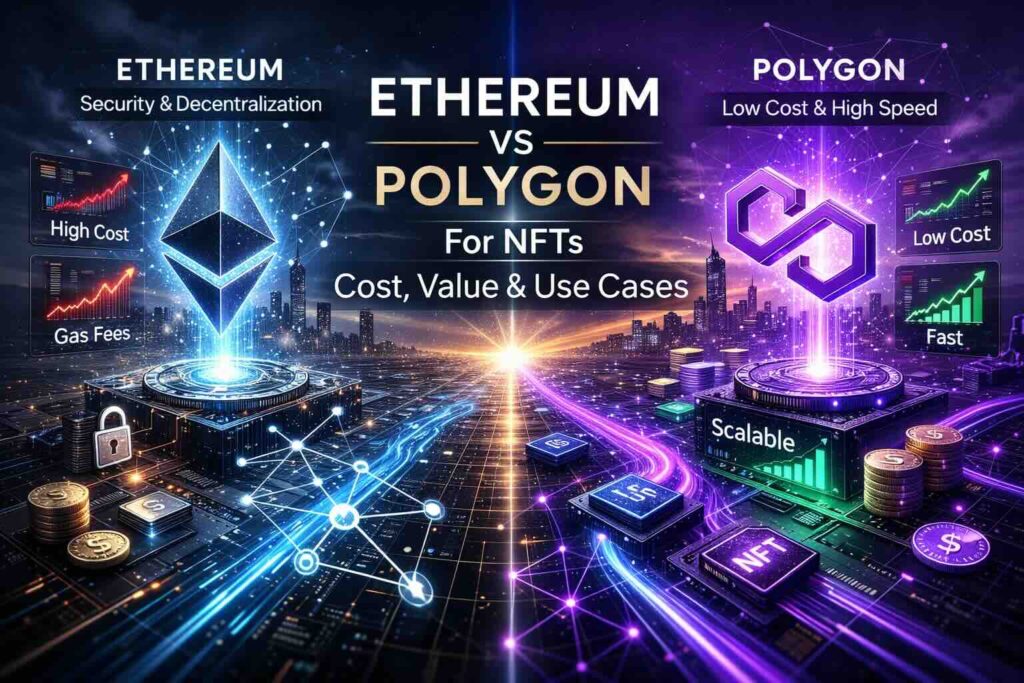
This comparison examines Ethereum and Polygon in terms of NFT minting costs, gas fees, scalability, and Layer 2 architecture.
The most common comparison is Ethereum (ETH) vs Polygon.
Both networks dominate the NFT ecosystem, but they serve different purposes.
This guide explains the key differences between Ethereum and Polygon for NFTs,
including gas fees, security, market value, liquidity, and ideal use cases.
1. Ethereum vs Polygon: Technical Foundation
Ethereum is the original smart contract blockchain where NFT standards such as
ERC-721 and ERC-1155 became widely adopted.
It is considered the main chain for high-value NFT projects.
Polygon is a Layer 2 (L2) scaling solution built to improve Ethereum’s scalability.
It is fully compatible with Ethereum but operates with lower fees and faster transactions.
Summary:
- Ethereum: Mainnet, high security, strong decentralization
- Polygon: Layer 2 network, low fees, fast processing
2. Gas Fees and NFT Minting Costs
One of the biggest differences between Ethereum and Polygon NFTs is gas fees.
On Ethereum, NFT minting costs can range from tens to hundreds of dollars during network congestion.
This creates a financial barrier but also reinforces scarcity and commitment.
On Polygon, minting fees are extremely low—often just a few cents.
This makes it ideal for large NFT collections, community distribution, and experimental projects.
Summary:
- Ethereum NFT gas fees: High, but associated with premium positioning
- Polygon NFT fees: Very low, accessible to beginners
3. Market Value and Collector Perception
Ethereum remains the dominant blockchain for high-value NFT art.
Most blue-chip NFT collections and major digital artists use Ethereum.
Collectors often associate ETH NFTs with stronger asset value and long-term investment potential.
Polygon NFTs are widely used in gaming, ticketing, digital identity,
and large-scale Web3 applications.
They emphasize usability and adoption rather than speculative price growth.
Summary:
- Ethereum: Strong collector confidence, high-value NFT market
- Polygon: Utility-driven, scalable Web3 adoption
4. Liquidity and Secondary Market Activity
Liquidity refers to how easily NFTs can be resold.
Ethereum NFTs generally have higher secondary market liquidity,
especially for established collections.
Polygon NFTs may have lower average resale prices,
but they benefit from lower transaction friction and broader accessibility.
For creators targeting investment-focused collectors,
Ethereum often provides deeper liquidity.
For creators focused on community growth,
Polygon reduces entry barriers.
5. Environmental Considerations
Ethereum transitioned to Proof of Stake (PoS),
significantly reducing energy consumption.
However, it still carries the perception of a heavy mainnet infrastructure.
Polygon emphasizes efficiency and sustainability,
which makes it attractive for enterprise adoption and CSR-focused projects.
6. Which Blockchain Is Best for Your NFT Project?
The best blockchain for NFTs depends on your objective.
Choose Ethereum if:
- You prioritize scarcity and high-value NFT art
- You target investment-focused collectors
- You want strong market positioning
Choose Polygon if:
- You focus on community building
- You plan large-scale NFT distribution
- You want minimal minting costs
- You are launching beginner-friendly projects
7. Ethereum and Polygon: Competition or Complement?
Ethereum and Polygon are not strict competitors.
They represent complementary layers within the Web3 ecosystem.
Ethereum provides security, decentralization, and high-value positioning.
Polygon enhances scalability, accessibility, and user experience.
As Web3 matures, both networks will likely coexist—
serving different segments of the NFT market.
Conclusion: The Blockchain You Choose Shapes Your NFT Identity
The difference between Ethereum and Polygon in NFTs is not only technical.
It reflects how you position value.
- Ethereum: Scarcity, trust, asset value
- Polygon: Accessibility, scalability, adoption
The choice between ETH and Polygon ultimately shapes the identity of your NFT project.
In Web3, technology is not neutral—it defines perception.