
Civilization Without a Center, and the Choice to Leave Only Structure
— The Jomon Spirit and the Resonance of a Decentralized Thought —
Underlying Structure
Underlying this creative process is the Jomon spirit,
a way of civilization that existed in the Japanese archipelago
for over ten thousand years.
It was not merely an ancient culture,
but a rare form of society that functioned
without centralized authority or rulers.
Autonomous Communities
Jomon society did not establish kingship, ruling classes,
or centralized governance.
Instead, it consisted of autonomous communal settlements—
self-sustaining villages connected through exchange,
ritual practice, seasonal movement, and kinship.
What held these communities together was not command or coercion,
but consensus, reciprocity, and continuity over time.
Resilient Structure
Stability did not arise from declared ideals
or enforced rules.
It emerged from structures that were inherently resilient.
Society did not depend on who was right,
but on what could endure.
Life Without Doctrine
The essence of the Jomon spirit was never articulated as doctrine.
There was no leader to follow,
no truth to proclaim,
and no authority demanding belief.
And yet, the civilization endured.
What existed was not a system of persuasion,
but a structure that could be lived within.
A Quiet Resonance
This way of being finds a quiet resonance
with a modern decentralized line of thought
that also rejected central control and personal authority,
leaving only structure behind.
In that design,
no one stood at the center.
No name demanded recognition.
No message required belief.
Only an autonomous structure remained—
open to voluntary participation.
What Connects Them
What connects these two is not ideology,
ethics, or belief.
It is structure.
They demonstrate that societies can function
without domination or coercion,
and can endure without a central source of legitimacy.
Network, Not Hierarchy
The Jomon civilization persisted not because it conquered,
but because it adapted.
Its form resembled a network rather than a hierarchy—
centerless, distributed, and quietly resilient.
Placement Over Persuasion
This creative process values placement over persuasion.
It does not instruct or convince.
It simply leaves something in place.
Form as Meaning
In the Jomon era,
prayer and meaning were preserved
not through words,
but through form—
pottery, ritual objects, and lived gestures.
Today, this work adopts the same stance.
It exists not as a statement,
but as a space.
Civilizations do not last because they speak loudly.
They last because their structures remain.
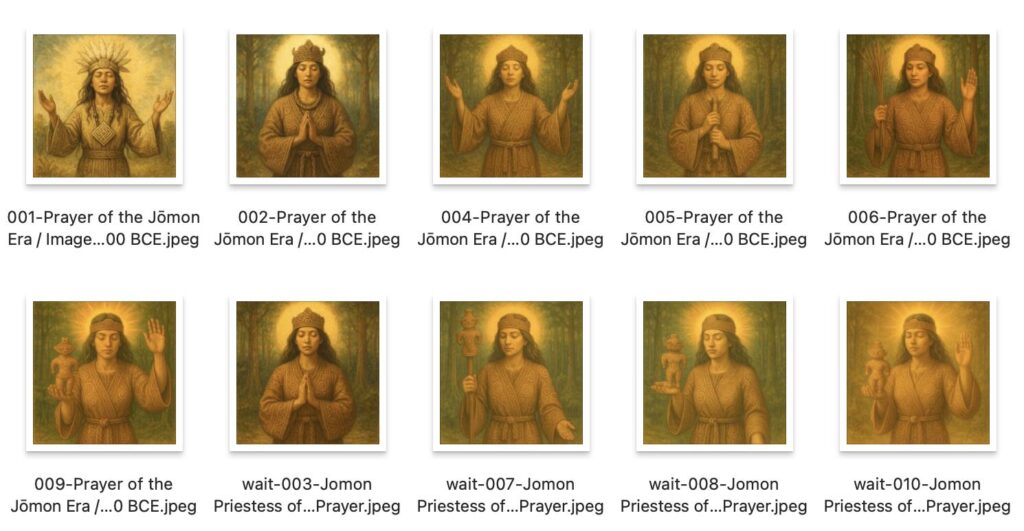
Prayer of the Jōmon Era / Image of Japan circa 10,000 BCE